by Riley Coburn, Georgetown University, Class of 2027
For the past three months, I have lived and worked in Germany as part of the Rhineland-Pfalz Transatlantic Ambassador Internship Program (RP-TAIP). The experience has allowed me to further develop my German language skills in a professional setting while gaining practical insight into the institutions and communities that sustain the transatlantic relationship. Working alongside the Atlantic Academy, the U.S. Forces Liaison Office, and the Rhineland-Pfalz State Chancellery provided three distinct yet complementary perspectives on foreign affairs, ranging from grassroots community engagement, military cooperation, as well as state-level diplomacy.
Phase 1 - Atlantic Academy
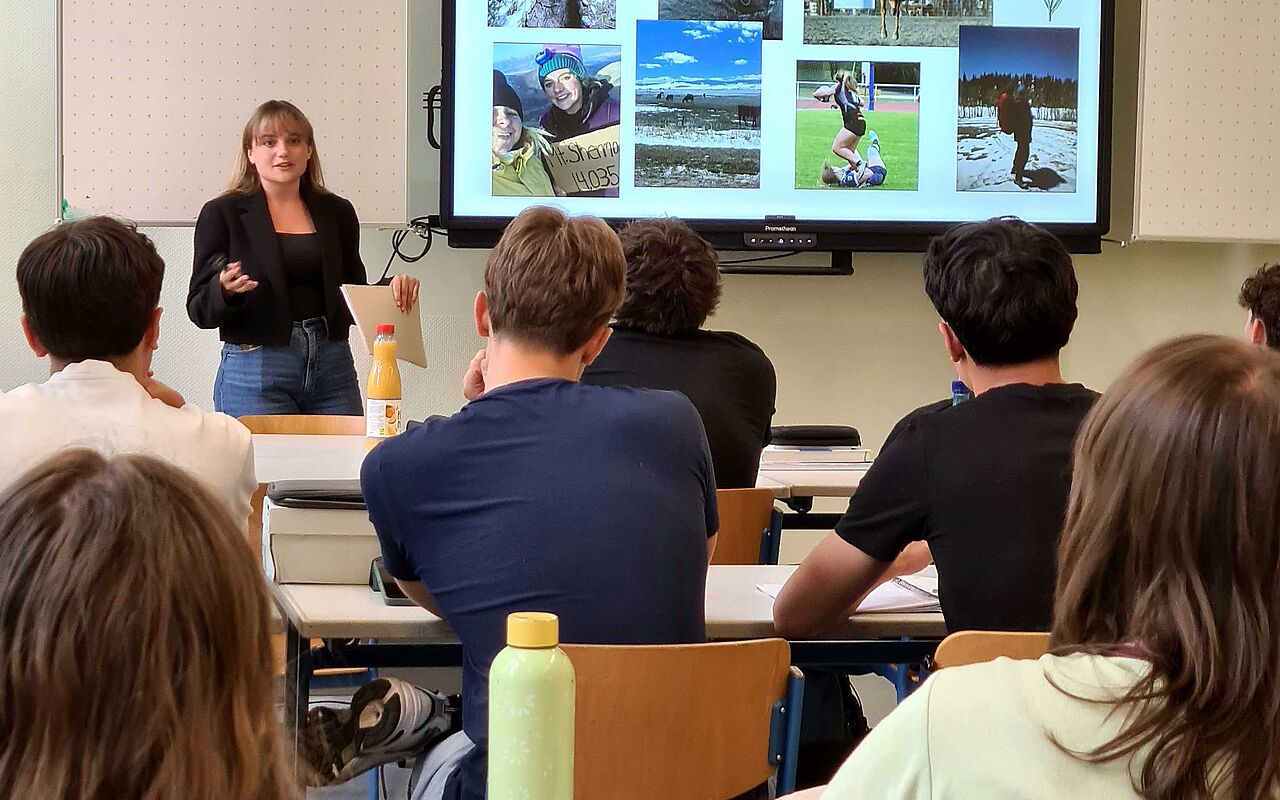
I began the internship with the Atlantic Academy in Kaiserslautern, where I supported research projects, educational programs, and public events. During my first week, I helped with a transatlantic exchange between students from Francis Marion University in South Carolina and the Rheinland-Pfälzische Technische Universität Kaiserslautern-Landau. In the following weeks, I visited several schools in Ramstein and Kaiserslautern, where I spoke with German students about growing up in Wyoming, studying in Washington DC, adapting to life in Germany, and the comparisons between American and German societies. These visits gave me a valuable perspective on how young Germans view the United States while also allowing me to better understand the German education system. Having visited both a Gymnasium and Berufsfachschule, I was particularly struck by how community education, encounters, and expert engagement can foster dialogue and strengthen cross-cultural understanding.
Beyond the Academy’s educational programming, I participated in several events including the U.S. Consulate’s celebration of America’s 250th year of independence and a seminar examining the intersection of Catholicism and American politics. Additionally, I went to the German-American Friendship Fest in Ramstein. There, I met local politicians such as the town Mayor, who discussed his responsibilities and role in maintaining relations with the U.S. military.
Phase 2 - U.S. Forces Liaison Office, Rhineland-Pfalz
The second phase of my internship placed me with the U.S. Forces Liaison Office (USFLO) in Mainz. Here my work shifted from community education toward coordination between local German government officials and U.S. military installations. My responsibilities included monitoring the news, conducting research on topics such as AI models, compiling contact information, and preparing biographies and background materials for briefings.
A particularly valuable component of my time with USFLO was the opportunity to participate in field visits throughout the surrounding military community. I attended several change-of-command ceremonies at U.S. Army installations in Rheinland-Pfalz and even visited the headquarters of U.S. Army Europe and Africa. I also observed an informational exchange between German police forces and personnel at the Clay Kaserne intelligence center, which highlighted the importance of cooperation between American and German security institutions.
Later at Ramstein Air Base, I met with personnel from the Host Nation Office and received a tour of the installation. Seeing the infrastructure and daily life of the base allowed me to conceptualize the true scale and depth of America’s presence in Germany.
Phase 3 - State Chancellery of Rhineland-Pfalz
For the final phase of the internship, I joined the Europe and International Affairs Department at the Rhineland-Pfalz State Chancellery in Mainz. Here, I researched and drafted briefings on the U.S. Midterm Elections and examined the future of Rheinland-Pfalz’s partnership with South Carolina. From the research and attending various meetings, I experienced the state government’s role in international affairs and the ways in which it maintains its own network of foreign partnerships and cross-border cooperation.
During this phase, I also had the opportunity to travel around Germany. I spent a week in Berlin working with the Landesvertretung Rheinland-Pfalz, learning how the state is represented at the federal level. After visiting the Bundestag, Bundesrat, and Bundesnachrichtendienst, I gained a better understanding of the dynamic between state and national institutions. The following week, I traveled to Lambrecht for a week-long lecture series, “American Disruption: Domestic and Global Tipping Points”. The program brought together experts from academia, journalism, and the military to discuss the history and current challenges of the transatlantic relationship. Engaging with these perspectives alongside German peers broadened my understanding of the changing political and security landscape in which the German-American relationship operates.
Program Summary
Due to its emphasis on local and state-level institutions, the three phases of the RP-TAIP displayed that the transatlantic relationship is sustained through continuous coordination of military, government, and local actors and not just through high-level diplomatic agreements in Berlin or Washington. After living and working within the communities that surround U.S. military installations, I now understand the extent to which the transatlantic relationship shapes not only national policy priorities, but the daily life of citizens. Completing this internship was a defining moment of my graduate studies and has better prepared me both academically and professionally for what comes next. I will forever be grateful for participating in this program and for the lifelong friendships I have made along the way.